NIKE, Inc. (NYSE: NKE)
Initiation of coverage · Consumer discretionary
A twelve-year low is not the same as cheap. On normalized earnings, this one is not.
The full 8-page research note
The normalized-earnings model, the reverse DCF, the segment breakdown, scenarios, and full disclosures. Free, no email required.
The call
We are initiating on Nike with a HOLD and a $32 fair value.
Nike trades at a twelve-year low, down more than three quarters from its 2021 peak, and every instinct says a franchise this strong is a bargain here. We spent this report trying to justify that instinct and could not. The stock is cheap against a number that is not real.
Reported fiscal 2026 earnings were $2.10 a share, which puts the stock at 18.3 times. But the fourth quarter included a one-time $986M recovery of tariffs paid under the International Emergency Economic Powers Act, which added $0.52 to earnings per share. Strip it, and normalized earnings are about $1.77. The real multiple is 21.7 times, not 18.3.
For a business whose revenue is flat to declining, whose Greater China sales have fallen about 30 percent, and whose Converse brand is shrinking at 31 percent, 22 times is not a distressed valuation. It is a full one.
We asked the question backwards, the way we always do. At a 9 percent discount rate, $38.44 already assumes Nike compounds owner earnings at about 8.7 percent a year for a decade. That is not a pessimistic number the market has beaten the stock down to. It is an optimistic one that still has to come true.
The multiple that is not real
The single most quoted fact about Nike right now is that it trades near 18 times earnings, cheaper than it has been in over a decade. That fact is built on a number that will not repeat.
The fiscal fourth quarter carried a large one-time item: the expected recovery of $986M of IEEPA tariffs, which added roughly 900 basis points to fourth-quarter gross margin and $0.52 to earnings per share, turning a normalized quarter of about $0.20 into a reported $0.72. Removing it lifts the real multiple to 21.7 times.
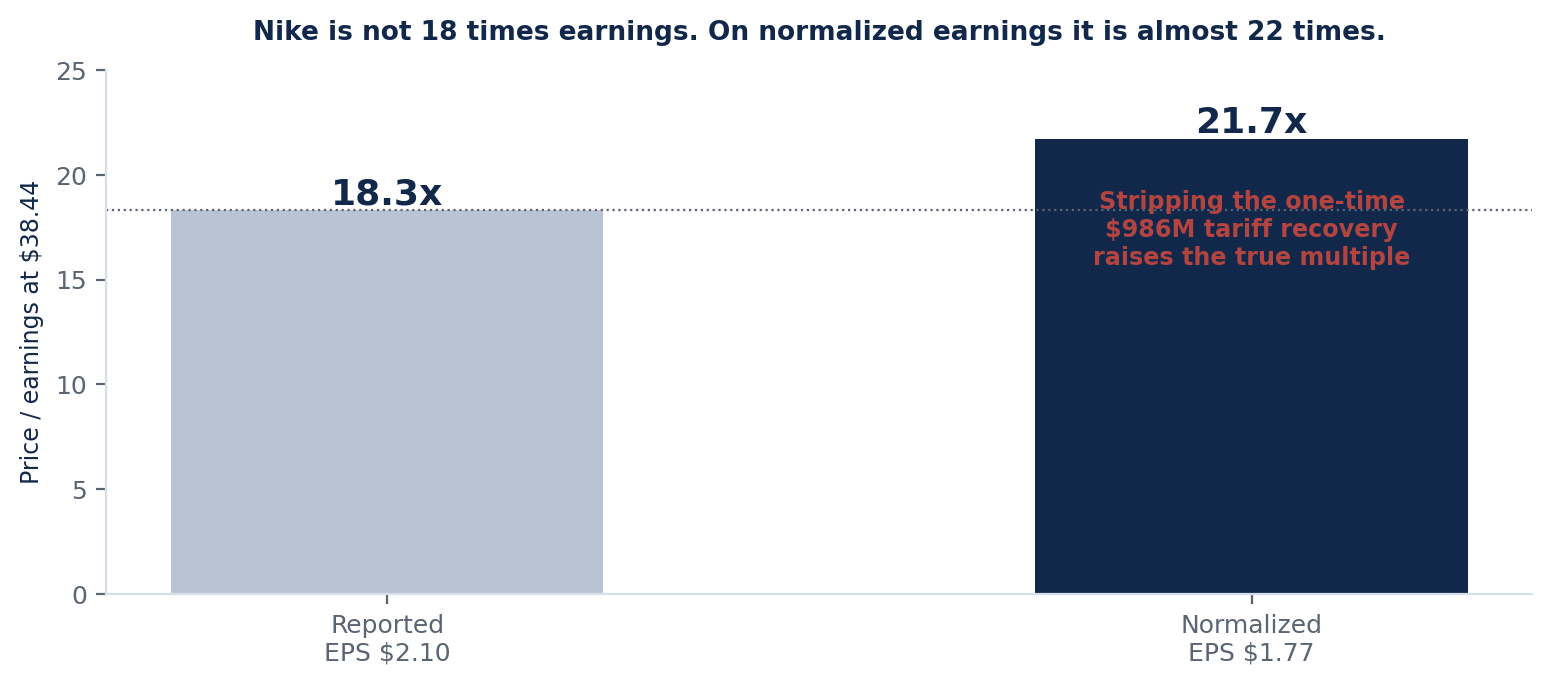
This is not an accounting scandal and Nike disclosed the item plainly. The point is narrower: the number doing the work in every bullish write-up is not the multiple you are actually paying for the ongoing business.
What the price assumes
Our house method values a business on discounted owner earnings, then checks the result by running it in reverse: given the price, what growth is the market already paying for? We take normalized owner earnings of about $2.1 billion, discount at 9 percent for a mega-cap consumer name with a beta of 1.11, and fade growth to 3 percent over a decade. Solving for the starting growth rate that equals today's $46 billion market capitalization gives 8.7 percent.
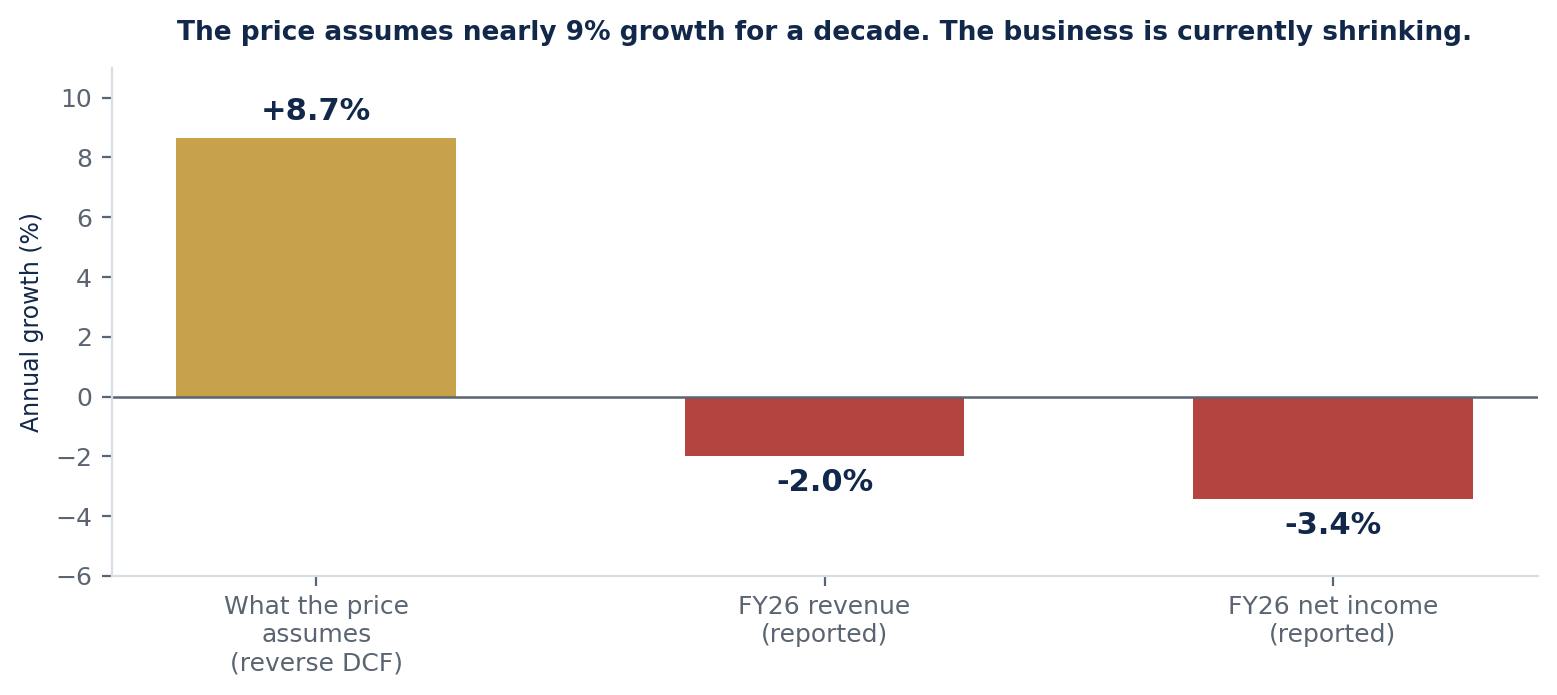
Set that against what the company reported for fiscal 2026: revenue down 2 percent in constant currency, net income down 3 percent, earnings per share down 3 percent. The market is paying for a strong recovery that has not yet appeared in the financials.
We tested the earnings figure against cash, because owner earnings should track free cash flow over time. It does, and not in Nike's favor this year. Fiscal 2026 free cash flow was about $2.0 billion, down roughly half from $3.3 billion the year before, and that still includes about $0.3 billion of one-time tariff cash. Normalized free cash flow is closer to $1.7 billion, below our normalized net income of $2.1 billion. Our owner-earnings estimate is, if anything, generous. Using the cash figure would lower fair value, not raise it.
The business today
A HOLD on a franchise this good requires understanding exactly what is broken, because the parts that work are the reason it is not a sell. Fiscal 2026 revenue was flat at $46.4 billion, but that flat line hides real divergence.
| Segment | Revenue | Trend |
|---|---|---|
| Nike Brand wholesale | $27.5B | up 6% |
| Nike Direct | $17.7B | down 6% |
| Nike Digital (within Direct) | n/a | down 12% |
| Converse | $1.2B | down 31% |
| Total Nike, Inc. | $46.4B | flat |
The good news is real. Wholesale grew 6 percent for the year, led by North America, as Nike deliberately rebuilt the retail partnerships it spent the prior few years walking away from. That reversal is the core of the current turnaround and it is showing early results.
The bad news is where the value went. Greater China revenue has fallen roughly 30 percent from its peak, driven by local competition and brand fatigue that new management inherited rather than caused. Nike Digital fell 12 percent as the direct-to-consumer strategy was unwound, and Converse is in free fall, down 31 percent across every territory.
The turnaround has leadership behind it: a returning chief executive who has spent the past year rebuilding wholesale relationships and refocusing the product organization around sport, plus a senior commercial leader brought in from outside retail to drive the recovery. Whether that team can restore growth is the entire bull case, and it is genuinely open. What it is not yet is visible in the revenue line.
The bull case, and why this is a HOLD and not a SELL
Everything above argues the stock is ahead of the fundamentals. None of it argues that Nike is a bad business, and the opposing case is strong enough that a sell would overstate our conviction.
The brand is not impaired, the cycle is. Nike remains the largest athletic brand in the world. The decline is cyclical and self-inflicted, the product of a strategic detour into direct-to-consumer now being corrected, not evidence that consumers have abandoned the swoosh. Impaired brands do not grow North America wholesale 6 percent in a down year.
The balance sheet pays you to wait. The dividend yields about 4.3 percent, was raised 5 percent last year, and is backed by $9 billion of cash and short-term investments. Nike returned $2.5 billion to shareholders in fiscal 2026. A patient holder is paid to wait for the turnaround to land.
The turnaround is early, not absent. The wholesale reversal is working, inventory is under control at $7.5 billion, and management is executing a coherent plan. If it restores even mid-single-digit growth, the bull case is correct and the stock is modestly undervalued today.
Every one of those points is true, and the price already reflects them. To pay today's price you have to underwrite roughly 9 percent growth for a decade, which is more than the turnaround has delivered and more than the base case can honestly assume. We would rather own the recovery once the price gives us the growth for free, which today it does not.
Scenarios
| Bear | Base | Bull | |
|---|---|---|---|
| Starting growth | -2% | +4% | +8% |
| Discount rate | 9.5% | 9.0% | 8.5% |
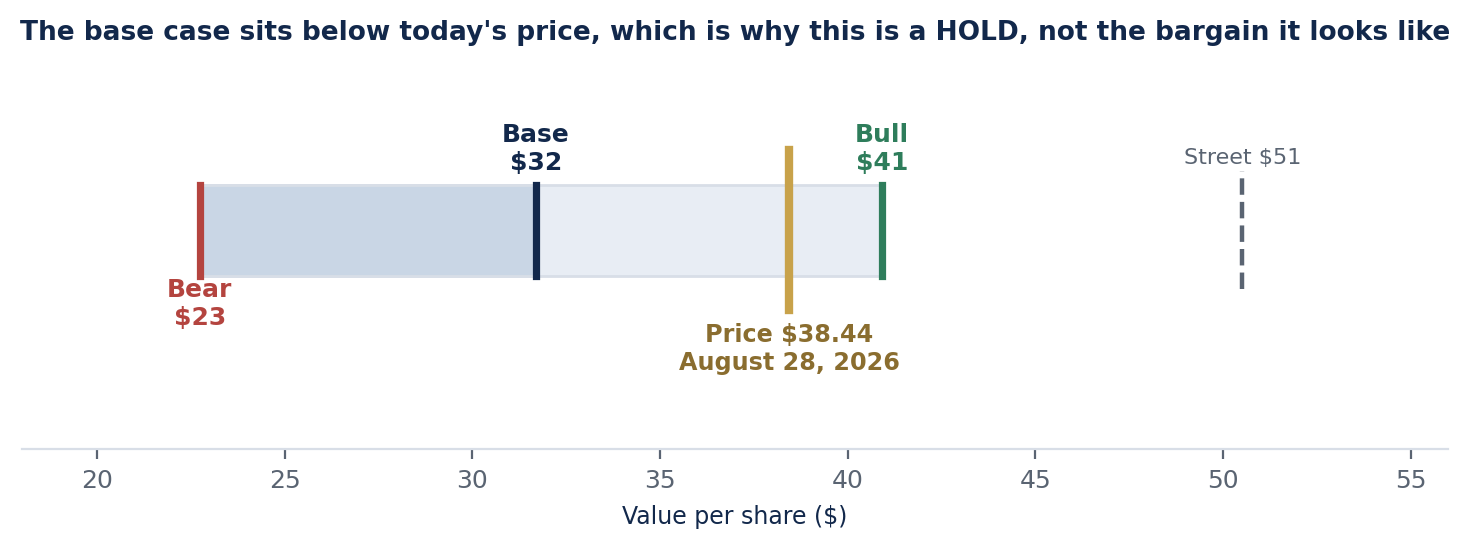
| Fair value | $22.74 | $31.69 | $40.91 |
| Return from today | -40.9% | -17.6% | +6.4% |
Bear. China does not stabilize, Converse keeps bleeding, and the wholesale recovery stalls. Owner earnings shrink slightly. Fair value $23, a 41 percent loss, almost exactly where the most bearish Street target sits.
Base. The turnaround takes hold slowly. Growth returns to about 4 percent as wholesale strength offsets continued China and Converse weakness, then fades. Fair value $32, or -18 percent below today before the dividend, which is why this is a HOLD.
Bull. Management executes, China finds a floor, and Nike compounds owner earnings at 8 percent. Fair value $41, modestly above today. This is the case the Street underwrites at an average target of $51. It is not unreasonable. It simply has to happen, rather than being paid for after it does.
Note how wide the analyst range is: from $23 to $94, the largest disagreement in large-cap consumer. That spread is the tell that this is a genuine debate about whether the turnaround works, and our HOLD sits deliberately in the middle of it: closer to the skeptics on valuation, closer to the bulls on the quality of the business.
Risks
Because this is a HOLD, the risks run both ways, and we would rather state what would move us than pretend to certainty.
What would move us to BUY: the price falling toward the bear case without further deterioration in fundamentals; Greater China revenue stabilizing for two or more quarters; gross margin expanding on a clean basis without one-time items; or the wholesale recovery broadening beyond North America.
What would move us to SELL: the revenue decline accelerating rather than stabilizing; gross margin falling as promotions deepen to clear product; dividend growth stopping, which would signal balance-sheet strain; or inventory building again and forcing markdowns.
Where our method could be wrong: the single most contestable input is normalized owner earnings. We used $2.1 billion; the cash flow statement argues for less, and a bull would argue a recovery year restores more. The discount rate carries much of the answer, too. At 8 percent rather than 9, the implied growth the price assumes drops to 4.2 percent. And we treat the China decline as cyclical. If it is structural, even the bear case is too generous.
Related research
Reports that make a similar argument about a different business. Every call on this site is dated, public and scored the same way, whether it worked or not.
- UnitedHealth, the same mistake in reverse: there the first half flatters, here a one-time recovery does.
- Costco, another consumer brand where the business is not the question and the price is.
- Progressive, a third case where the reported multiple and the real one are far apart.
The full list, with the price each call was made at, is on the scoreboard.
Sources & scoring
All company figures are taken from the primary source: NIKE, Inc.'s fiscal 2026 fourth quarter and full year results, released June 30, 2026 for the year ended May 31, 2026. Free cash flow was cross-checked against the fiscal 2026 filing as reported by market-data aggregators. Every figure was computed by script from those documents.
The reference price of $38.44 is the closing price on August 28, 2026, the last completed trading session before publication, confirmed on the Cboe real-time tape via Morningstar and matched by Macrotrends. Our corrections policy requires agreement across independent sources; the prior session closed at $38.59. This report is dated August 31, 2026, the following Monday.
This call will be scored on August 31, 2027 against the total return of the S&P 500 over the same period. A HOLD is recorded as correct if the excess return of NKE against the benchmark falls within five percentage points in either direction. The rule was fixed before the result is known and will not be revised afterward. See how calls are scored.
The full 8-page research note
The full normalized-earnings model, the reverse DCF, the segment table, the two-way risk framework, and methodology.