Initiation of coverage · Energy royalties & land
Texas Pacific Land (NYSE: TPL)
A remarkable business, priced for the option rather than the operation.
The full 8-page research note
Valuation model, oil price sensitivity, the bull-case debate, risk matrix, and full disclosures. Free, no email required.
The call
We are initiating on Texas Pacific Land with a HOLD and a $321 fair value.
TPL is one of the highest-quality businesses in American energy, and we want to say that plainly before explaining why we are not buying it. The company owns roughly 894,006 surface acres and about 224,057 net royalty acres across the Permian Basin, collects royalties without drilling a well, carries no debt, and converted 88% of last quarter's revenue into adjusted EBITDA.
The second quarter of 2026 was a record on essentially every line. Revenue of $246.1M rose 31.2% year over year, net income of $153.9M rose 32.5%, and free cash flow reached $155.5M.
Our hesitation is about what produced that record. TPL realized $97.55 per barrel of oil in the quarter, against $70.57 in the first. The company is deliberately unhedged, so an unusually strong oil market flows straight to the bottom line. It also flows straight back out when prices normalize.
At $70 oil the same asset base earns roughly $7.48 a share, which puts the stock near 46× earnings and a 2.3% free cash flow yield.
| Market cap | $23.5B | Enterprise value | $23.2B |
| Net cash | $249M | Debt | None |
| Q2'26 revenue | $246.1M (+31.2%) | Q2'26 EPS | $2.23 (+32.5%) |
| Adj. EBITDA margin | 88% | FCF margin | 63% |
| P/E (TTM) | 43.4× | EV/EBITDA (TTM) | 31.0× |
| FCF yield | 2.27% | Dividend yield | 0.70% |
| Surface acres | 894,006 | Net royalty acres | 224,057 |
| Q2 production | 39.7 MBoe/d | Q2 realized oil | $97.55/Bbl |
What you are actually buying
TPL is not an oil company. It does not drill, does not operate, and does not carry the cost of either. It owns land, and it owns the right to a share of what comes out of land it does not even own. Those are different businesses with very different economics, and conflating them is the most common error in analyzing this security.
Three revenue engines sit on the same acreage, which is the structural elegance of the thing. Oil and gas royalties, a perpetual non-cost-bearing share of production, produced $145.6M in the second quarter. Water, both sourced and treated sales plus produced water royalties, added $76.8M. Surface income from easements, commercial leases and materials contributed $23.7M, the smallest line today and the one with the widest range of future outcomes.
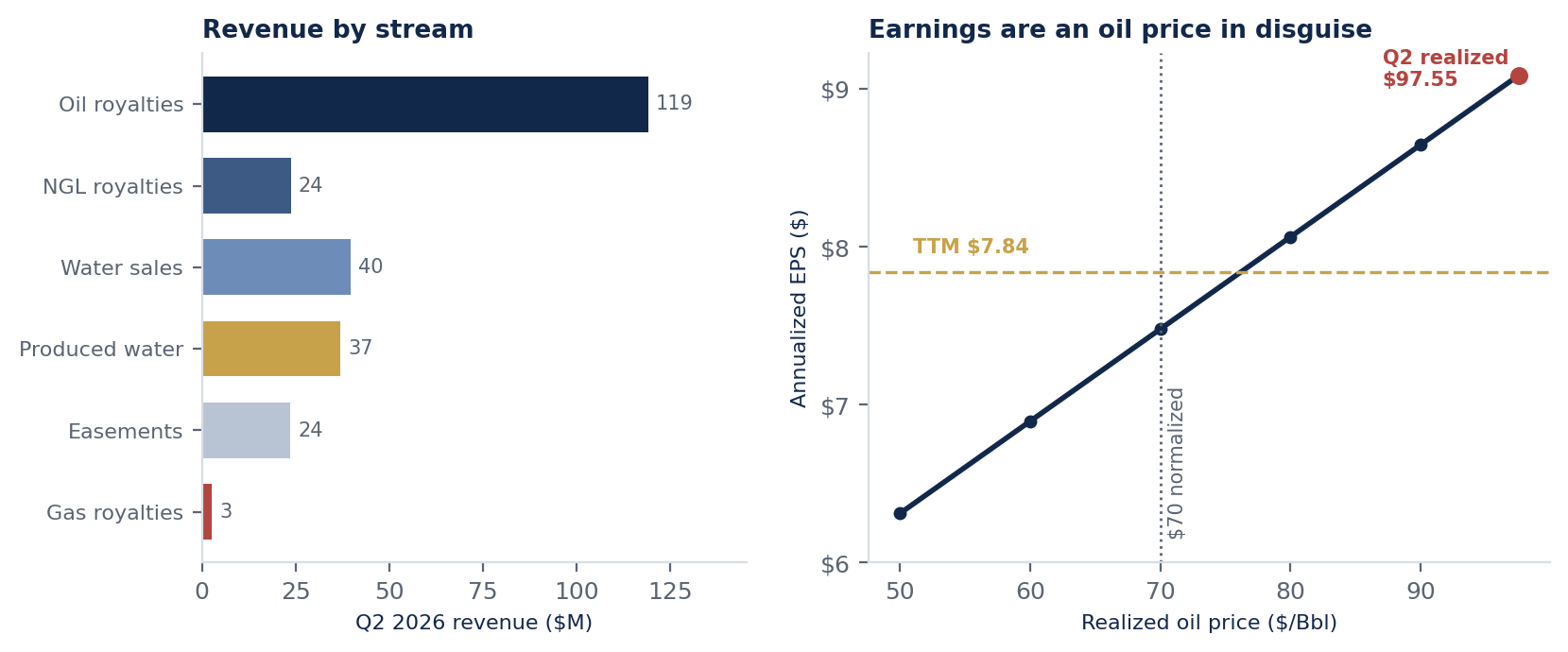
The concentration is the point. In the second quarter TPL produced 24% more natural gas than in the first and collected 73% less gas royalty revenue, at a realized price of $0.40 per Mcf. Takeaway constraints out of the basin mean associated gas is close to worthless at the wellhead.
The balance sheet is genuinely unusual: zero drawn debt against a $500M undrawn revolver, $249M of cash, and no drilling obligation of any kind. There is no scenario in which this company is a forced seller of anything, which is worth more than it sounds during a commodity downturn.
A record built on a price, not a business
The results were excellent and we do not want to diminish them. Revenue rose 31.2% year over year to $246.1M. Adjusted EBITDA of $215.6M carried an 88% margin. Royalty production hit a record 39.7 MBoe/d, up 19.6% year over year, helped by the net royalty acres acquired in the Midland Basin in November 2025.
Three things moved the wrong way underneath the record, and each is a leading rather than a lagging indicator.
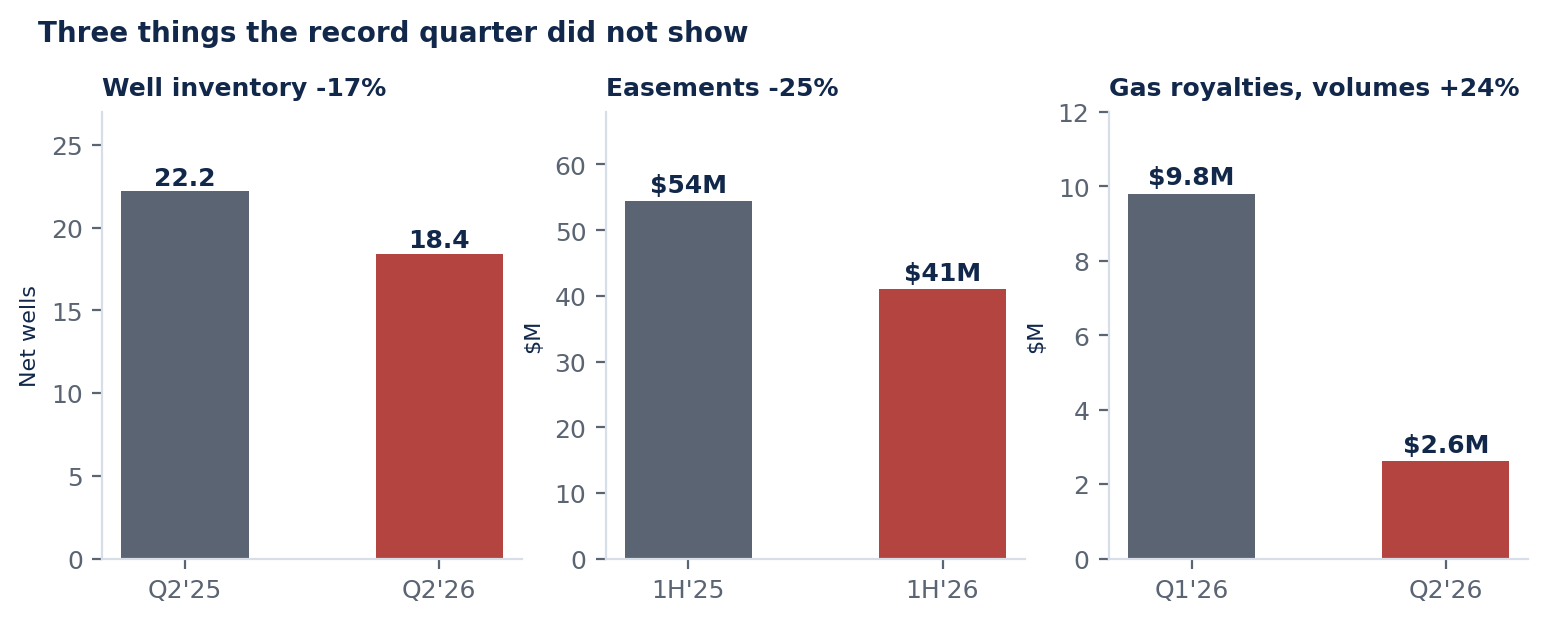
Well inventory fell 17%. Net permits, drilled-but-uncompleted wells and completed-but-not-producing wells totalled 18.4 net wells at June 30, against 22.2 a year earlier. That inventory converts into future royalty volume, so a shrinking number is the clearest early signal of operator activity slowing on TPL acreage.
Easements fell 25% year over year in the first half, from $54.4M to $41.0M. This is the surface business, which is precisely the line the data center thesis says should be growing.
Water sales volumes fell 19% sequentially, from 819 to 663 thousand barrels per day, partly offset by better pricing.
None of these is alarming on its own, and one quarter is not a trend. Together they suggest the operating momentum depends more on the oil price and on last year's acquisition than the record headline implies.
The debate, adjudicated
The bull case
Our response
Valuation, and what the price already assumes
We value TPL on enterprise value to adjusted EBITDA, because the royalty stream is perpetual, capital requirements are minimal, and there is no debt to complicate the bridge.
The most useful exercise is not our fair value but the implied expectation. Holding volumes and the water and surface businesses at the second-quarter run rate, this is the oil price required to justify today's price at a range of exit multiples.
| Exit multiple | Required EBITDA | Implied oil price |
|---|---|---|
| 24× | $969M | $116/Bbl |
| 29× | $802M | $84/Bbl |
| 31× | $750M | $73/Bbl |
| 34× | $684M | $61/Bbl |
| 40× | $581M | $40/Bbl |
At roughly today's 31×, the stock is priced for about $73 oil. That is not an absurd assumption, and it is the reason this is a HOLD rather than a SELL. But it means there is no margin of safety: you need a normal oil price and a multiple that stays near three times the royalty peer group.
| Realized oil | Adj. EBITDA | EPS | FCF/share | P/E at $340.65 |
|---|---|---|---|---|
| $50.00 | $630M | $6.31 | $6.66 | 54.0× |
| $60.00 | $681M | $6.90 | $7.24 | 49.4× |
| $70.00 | $732M | $7.48 | $7.82 | 45.5× |
| $80.00 | $783M | $8.06 | $8.41 | 42.2× |
| $90.00 | $835M | $8.65 | $8.99 | 39.4× |
| $97.55 | $873M | $9.09 | $9.43 | 37.5× |
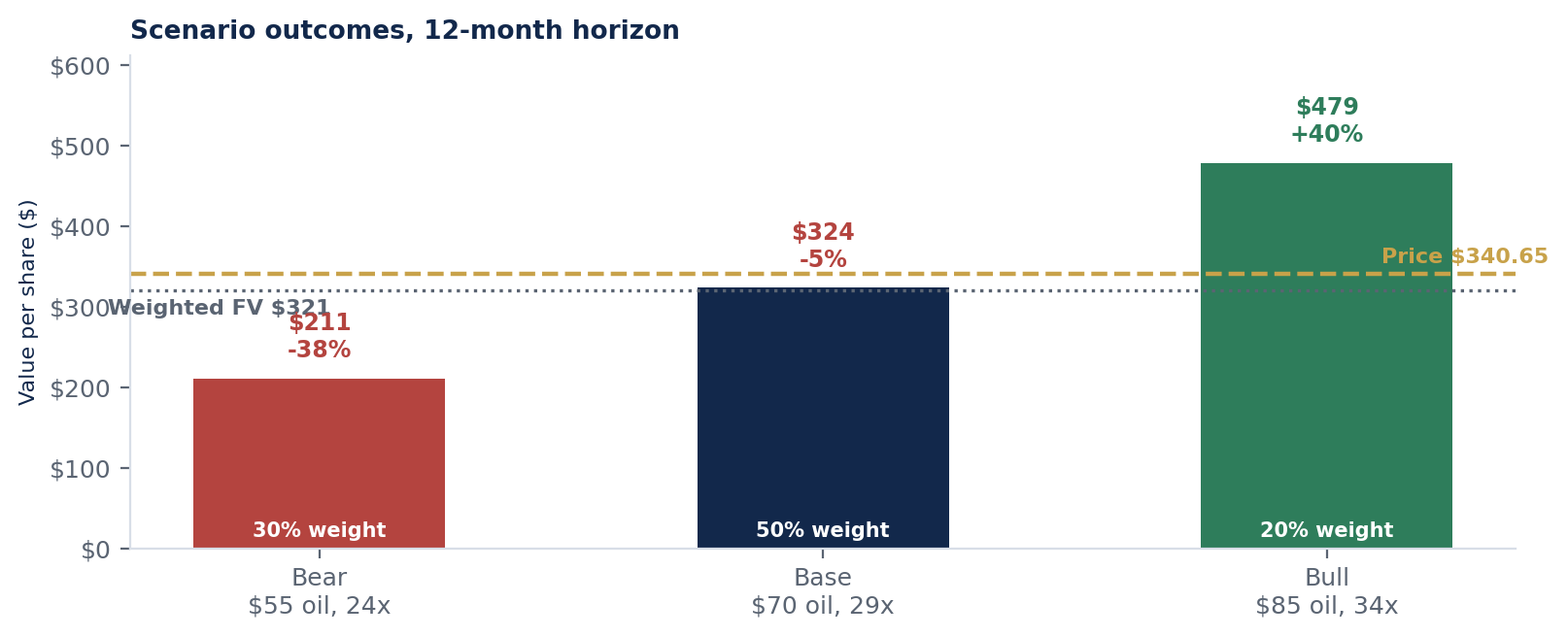
| Scenario | Oil | Adj. EBITDA | Multiple | Value/share | Return | Weight |
|---|---|---|---|---|---|---|
| Bear | $55 | $596M | 24× | $210.96 | -38.1% | 30% |
| Base | $70 | $762M | 29× | $323.82 | -4.9% | 50% |
| Bull | $85 | $964M | 34× | $478.58 | +40.5% | 20% |
| Weighted | $320.91 | -5.1% | 100% |
Bear. Oil settles near $55. Permian activity slows, the net well inventory keeps shrinking, water volumes flatten, and the data center optionality stays an option. Multiple compresses toward the royalty peer group.
Base. Oil normalizes near $70, the level that clears most Permian budgets. Modest volume growth from the Midland acreage, water grows with produced volumes, and Project Kilby proceeds without further large deals signed.
Bull. Oil holds near $85, surface monetization accelerates as power and water scarcity bites in West Texas, additional data center or power agreements follow Kilby, and desalination reaches commercial scale.
Risks
Oil price is the dominant variable by a wide margin. Annualized EPS moves from $6.31 at $50 oil to $9.09 at the Q2 realized price. TPL is deliberately unhedged, so this is undamped in both directions.
Multiple compression is the second. Most of the bear case is multiple, not earnings. If the market decides to value TPL as a royalty company rather than a land bank with optionality, the de-rating is severe regardless of results.
Operator activity is outside the company's control entirely. TPL receives whatever its operators choose to produce, and a sustained Permian slowdown feeds through with a lag of several quarters.
The data center optionality may not convert. The Kilby agreement includes a put option held by the developer and a call option held by TPL if development milestones are not achieved, which is a candid acknowledgment that these projects can stall. Power interconnection and permitting timelines in Texas are long. We wrote about why the power constraint is the binding one in a recent note; TPL sits on exactly the right side of that argument, which is part of what makes the valuation hard.
Governance concentration. Horizon Kinetics is the largest stockholder and holds a board seat following the appointment of Peter Doyle in May 2026. That aligns interests and concentrates influence at the same time.
The bottom line
Texas Pacific Land is a better business than almost anything else in energy. We are not arguing with the quality; we are arguing with the price. At 31× EV/EBITDA the market is paying roughly three times the royalty peer multiple, on earnings inflated by a $97.55 oil price, for a surface option that has so far produced one agreement.
Own the business at a price that does not require both a normal oil price and a permanently generous multiple. Our fair value is $321. We would get interested nearer $211 to $267, which would offer a margin of safety against a normal oil price rather than requiring one.
Related research
Reports that make a similar argument about a different business. Every call on this site is dated, public and scored the same way, whether it worked or not.
- Costco, another exceptional business where the price already reflects the exceptionality.
- Progressive, a second case where the reported number is not the number to value it on.
- Taiwan Semiconductor, a business with a structural position, priced as though the position were ordinary.
The full list, with the price each call was made at, is on the scoreboard.
Sources & scoring
All company figures are taken from primary filings and releases: the Form 10-Q for the quarter ended June 30, 2026, filed August 5, 2026; the second quarter 2026 earnings release; and the fourth quarter and full year 2025 release of February 18, 2026. The reference price of $340.65 is the closing price on August 7, 2026, the last trading day before publication. No figure in this report was estimated where a reported figure exists.
Trailing twelve month figures are derived as fiscal 2025 less the first half of 2025 plus the first half of 2026, because the company does not report a trailing column. Royalty peer multiple ranges are our characterization and are used qualitatively; no peer figure is relied upon for the valuation.
This call will be scored on August 10, 2027 against the total return of the S&P 500 over the same period. A HOLD is recorded as correct if the excess return of TPL over the benchmark is below positive five percentage points. The rule was fixed before the result is known and will not be revised afterward. See how calls are scored.
The full 8-page research note
Everything above plus the financial summary, the full risk matrix, and methodology.