Palantir Technologies (NASDAQ: PLTR)
Initiation of coverage · Enterprise software / AI
The growth is real. So is the tax bill nobody is modeling.
The full 8-page research note
Valuation model, implied-expectations table, the bull-case debate, risk matrix, and full disclosures. Free, no email required.
The call
We are initiating on Palantir with a HOLD and a $163 fair value.
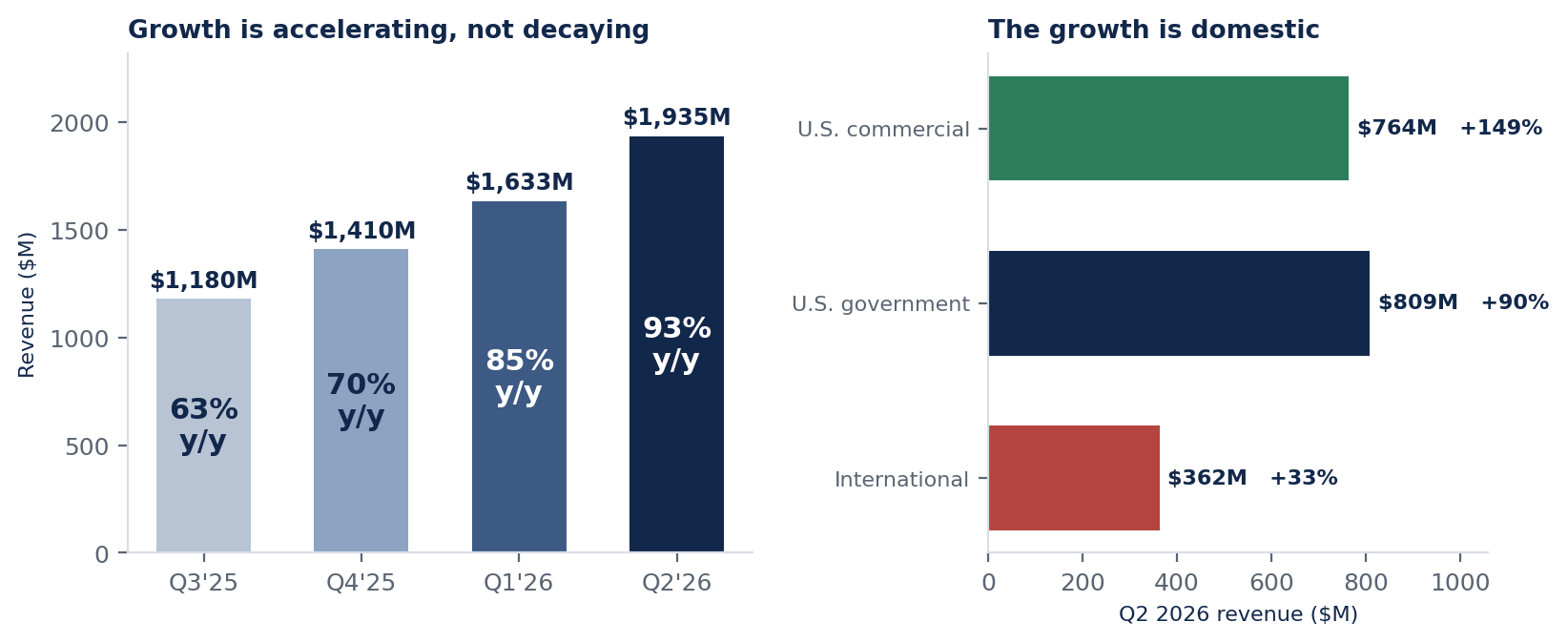
Start with what is not in dispute. Palantir grew revenue 93% year over year in the second quarter of 2026, to $1,935M. It did so while running an 85% gross margin and a 62% adjusted operating margin, and its Rule of 40 score reached 155. Growth is accelerating: 63%, then 70%, then 85%, now 93% across the last four quarters.
Companies at an $8B revenue run rate do not normally accelerate. We have looked for the catch in the operating numbers and we cannot find one. The bull case here is not a story, it is arithmetic, and anyone dismissing this as hype has not read the filings.
Our hesitation is entirely about price, and about one specific item inside the earnings that we think the market is capitalizing without adjusting. Palantir paid an effective tax rate of 1.4% in the quarter. Its own non-GAAP reconciliation assumes a long-term rate of 23%.
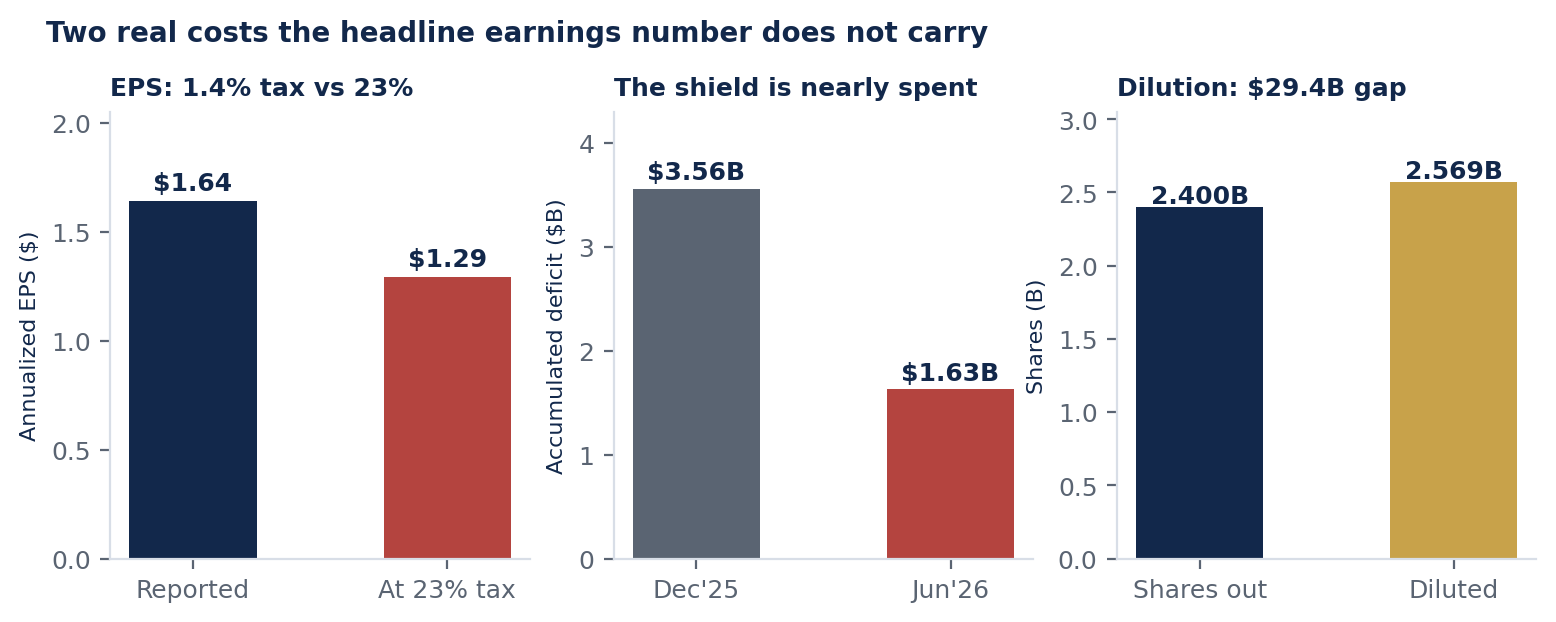
Normalize the tax rate to the company's own assumption and annualized EPS goes from $1.64 to $1.29. The multiple moves from 106× to 135×. Nothing about the business changes.
| Market cap (diluted) | $447B | Enterprise value | $438B |
| Net cash | $9.4B | Debt | None |
| Q2'26 revenue | $1,935M (+93%) | Q2'26 diluted EPS | $0.41 (+225% NI) |
| Gross margin | 85% | Adj. operating margin | 62% |
| Rule of 40 | 155 | FY26E revenue | $8.15B |
| EV / FY26E revenue | 54× | EV / FY26E adj. op. | 89× |
| P/E (annualized Q2) | 106× | P/E at 23% tax | 135× |
| Effective tax rate | 1.4% | From ATH close | -16% |
The bull case, stated as strongly as it deserves
We want to make the case for Palantir properly before we argue with it, because most bearish writing on this company attacks a version of the numbers that does not exist.
Revenue grew 93% to $1,935M and 19% sequentially. U.S. commercial revenue grew 149% to $764M; U.S. government grew 90% to $809M; total U.S. revenue rose 115%. GAAP operating margin was 47%, adjusted operating margin 62%, and adjusted free cash flow $1,220M at a 63% margin. The balance sheet carries $9.4B of cash and Treasuries against zero debt of any kind.
Management raised full-year revenue guidance to $8.15B to $8.16B, implying roughly 82% growth, and raised adjusted free cash flow guidance to $4.5B to $4.7B. Guidance has been raised at every quarter this year. This is not a company papering over a slowdown.
Two things inside the growth are worth noticing. First, it is almost entirely domestic. The U.S. is 81% of revenue and grew 115%. International revenue, the residual, was roughly $362M and grew about 33%. If the thesis is that AI sovereignty is a global phenomenon, the international line is not yet showing it.
Second, the backlog figure is a best case by construction. Palantir states plainly in its own release that total contract value, annual contract value and remaining deal value all presume the exercise of every contract option and no terminations, while the majority of its contracts are terminable, including for convenience. That does not make the 6.24B U.S. commercial remaining deal value wrong. It makes it a ceiling rather than a commitment.
The tax line, and why it matters
This is the part of the Palantir debate we think is genuinely underexamined, and it comes entirely from the company's own filings.
In the second quarter Palantir reported income before taxes of $1,081M and a provision for income taxes of $15M. That is an effective rate of 1.42%. For the first half the rate was 1.40%. A company earning nearly $2B before tax in six months paid under 1.5% on it.
This is not aggressive accounting. It is the ordinary consequence of years of losses producing carryforwards that now shelter profits. It is entirely legitimate, and it is entirely temporary.
Palantir agrees. In the reconciliation of adjusted earnings in the same release, the company applies an estimated long-term annual effective tax rate of 23%. That is the company's own view of what it will eventually pay, disclosed in a footnote on the same page as the 1.4% it actually paid.
| Q2 2026 | As reported | At 23% tax | Difference |
|---|---|---|---|
| Income before taxes | $1,081M | $1,081M | – |
| Provision for income taxes | $15M | $249M | $233M |
| Net income to common | $1,062M | $829M | $233M |
| Annualized diluted EPS | $1.64 | $1.29 | $0.35 |
| P/E at $174.04 | 106× | 135× | +29× |
Roughly $0.93B a year of reported earnings comes from a tax position the company itself does not expect to persist. On when it runs out, the balance sheet is suggestive: the accumulated deficit fell from $3.56B at December 31 to $1.63B at June 30, a reduction that exactly matches first-half net income. At that pace the remaining balance is absorbed within roughly three quarters.
We want to be precise about the limits of that inference. Accumulated deficit is a book measure and net operating loss carryforwards are a tax measure; they are related but not identical, and the timing of the step-up will depend on jurisdiction mix, valuation allowance releases, and stock compensation deductions. What is not in doubt is the direction, or the company's own stated destination of 23%.
The debate, adjudicated
The bull case
Our response
Valuation, and what the price already assumes
Palantir is not sensibly valued on trailing earnings, so we do not lead with them. We value it on enterprise value to forward revenue, which is how the market actually prices software at this growth rate, and we show what today's price implies rather than only what we think it is worth.
Holding the exit multiple constant across a range, this is the 2027 revenue that the current enterprise value of $438B requires, measured against this year's guided $8.15B.
| Exit EV/revenue | Implied FY27 revenue | Implied 2027 growth |
|---|---|---|
| 20× | $21.88B | +168% |
| 25× | $17.51B | +115% |
| 30× | $14.59B | +79% |
| 35× | $12.50B | +53% |
| 40× | $10.94B | +34% |
| 50× | $8.75B | +7% |
Read the middle rows carefully. To justify today's price on a 30× exit multiple, Palantir must grow revenue 79% in 2027, having grown 82% in 2026. To justify it on 40×, growth of 34% suffices, but the multiple has to stay near where it is today for another full year. Both are possible. Neither is conservative, and the price offers no compensation if either fails.
| Scenario | FY27 growth | FY27 revenue | Exit mult. | Value/share | Return | Weight |
|---|---|---|---|---|---|---|
| Bear | +40% | $11.42B | 20× | $90.73 | -47.9% | 30% |
| Base | +62% | $13.21B | 32× | $164.92 | -5.2% | 45% |
| Bull | +85% | $15.08B | 42× | $245.40 | +41.0% | 25% |
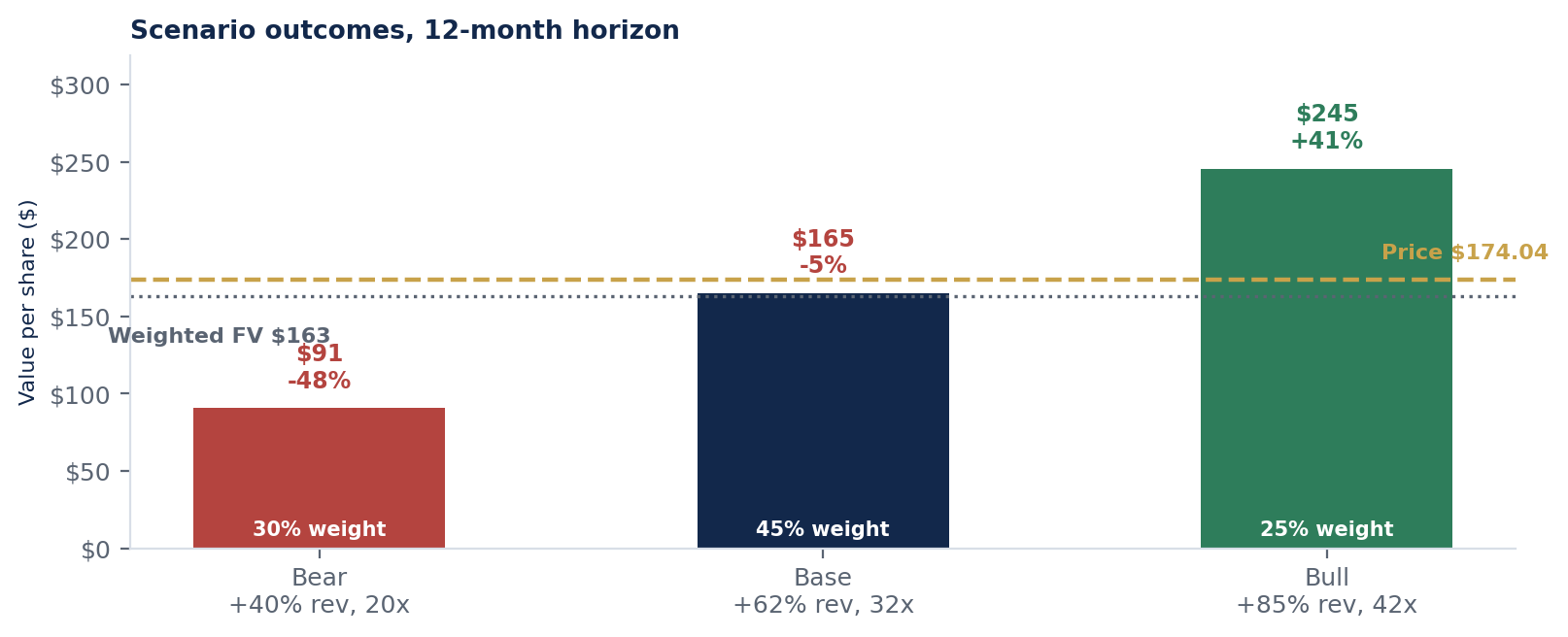
| Weighted | $162.79 | -6.5% | 100% |
Bear. Growth decelerates toward 40% as the U.S. commercial land-grab matures, and the multiple converges toward where high-growth software has historically settled.
Base. Growth moderates from 93% but stays exceptional, backlog converts on schedule, and the market keeps paying a large premium for 62% adjusted margins.
Bull. The 18-month runway management describes proves right, international finally inflects, and the multiple holds near where it sits today.
Risks
Multiple compression is the dominant risk, not earnings. Our bear case assumes no operational disaster at all: growth of 40%, which most software companies would celebrate, combined with a 20× multiple, still produces a price near $91. The valuation is the risk.
Tax normalization is worth roughly $0.93B of annual reported earnings. When it steps up, headline EPS growth decelerates sharply for reasons that have nothing to do with the business, at a moment when the stock is priced for uninterrupted acceleration.
Deceleration is arithmetic, not a forecast. Growth this fast is partly a function of a small base in U.S. commercial. As that base compounds, the same dollar additions produce lower percentages. Nothing has to go wrong; the only question is timing.
Government concentration carries political beta. U.S. government was $809M of the quarter. Federal contracting is exposed to budget cycles, administration changes, protests, and reputational controversy around specific agency deployments.
Backlog conversion could disappoint, since remaining deal value assumes all options exercised and no terminations. A gap between booked and realized would show up first as decelerating revenue against an unchanged backlog headline.
We wrote about why the physical layer of the AI build-out tends to keep more of the value than the application layer in a recent note. Palantir is the interesting counterexample: an application-layer company with genuinely exceptional economics. Whether that persists is the long-run question behind this rating.
The bottom line
This is the best operating performance on our coverage board. Growth accelerating through 93% at an $8B run rate, a 85% gross margin, a 62% adjusted operating margin, GAAP profitability, and $9.4B of net cash against no debt. We are not disputing the quality of the business, and we think the reflexive bear case on Palantir is lazy.
But at $174.04 the enterprise value is $438B, or 54 times this year's guided revenue. For that to be right, Palantir needs to grow roughly 79% again in 2027 and still command 30 times forward revenue at the end of it. Meanwhile the tax shield expires, worth about $0.93B a year of reported earnings.
We would rather own this at a price that does not need both. Our fair value is $163. We would get interested nearer $91 to $128.
Related research
Reports that make a similar argument about a different business. Every call on this site is dated, public and scored the same way, whether it worked or not.
- Uber, the other high-growth name, where the growth is priced very differently.
- Taiwan Semiconductor, growth nobody disputes, at a price that does dispute it.
- Nike, another case where an adjusted figure quietly leaves out a real cost.
The full list, with the price each call was made at, is on the scoreboard.
Sources & scoring
All company figures are taken from primary sources: the second quarter 2026 earnings release and accompanying condensed consolidated financial statements dated August 3, 2026; the first quarter 2026 release of May 4, 2026; and the Annual Report on Form 10-K for the fiscal year ended December 31, 2025. Quarterly figures for the first quarter of 2026 are derived by subtracting reported second quarter figures from reported first half figures. International revenue is derived as total revenue less disclosed U.S. revenue.
The reference price of $174.04 is the closing price on August 14, 2026, the last trading day before publication, verified against three independent sources; the prior session closed at $179.01. The all-time closing high of $207.18 was set on November 3, 2025. Palantir has not effected a stock split, so no per-share restatement applies. No figure in this report was estimated where a reported figure exists.
This call will be scored on August 15, 2027 against the total return of the S&P 500 over the same period. A HOLD is recorded as correct if the excess return of PLTR over the benchmark is below positive five percentage points. The rule was fixed before the result is known and will not be revised afterward. See how calls are scored.
The full 8-page research note
Everything above plus the financial summary, the full risk matrix, and methodology.