Uber Technologies (NYSE: UBER)
Initiation of coverage · Mobility / local commerce
The market is paying for 8% growth. The company is compounding at 22%.
The full 8-page research note
Valuation model, reverse DCF, the bear case in full, sensitivity grid, risk matrix, and full disclosures. Free, no email required.
The call
We are initiating on Uber with a BUY and a $91 fair value.
The stock is down 25% from its October 2025 high while the underlying business has done nothing but get better. In the second quarter of 2026 gross bookings grew 22% in constant currency to $58.0B, non-GAAP operating income grew 40%, and non-GAAP earnings per share grew 35%. Earnings are compounding at roughly twice the rate of the top line.
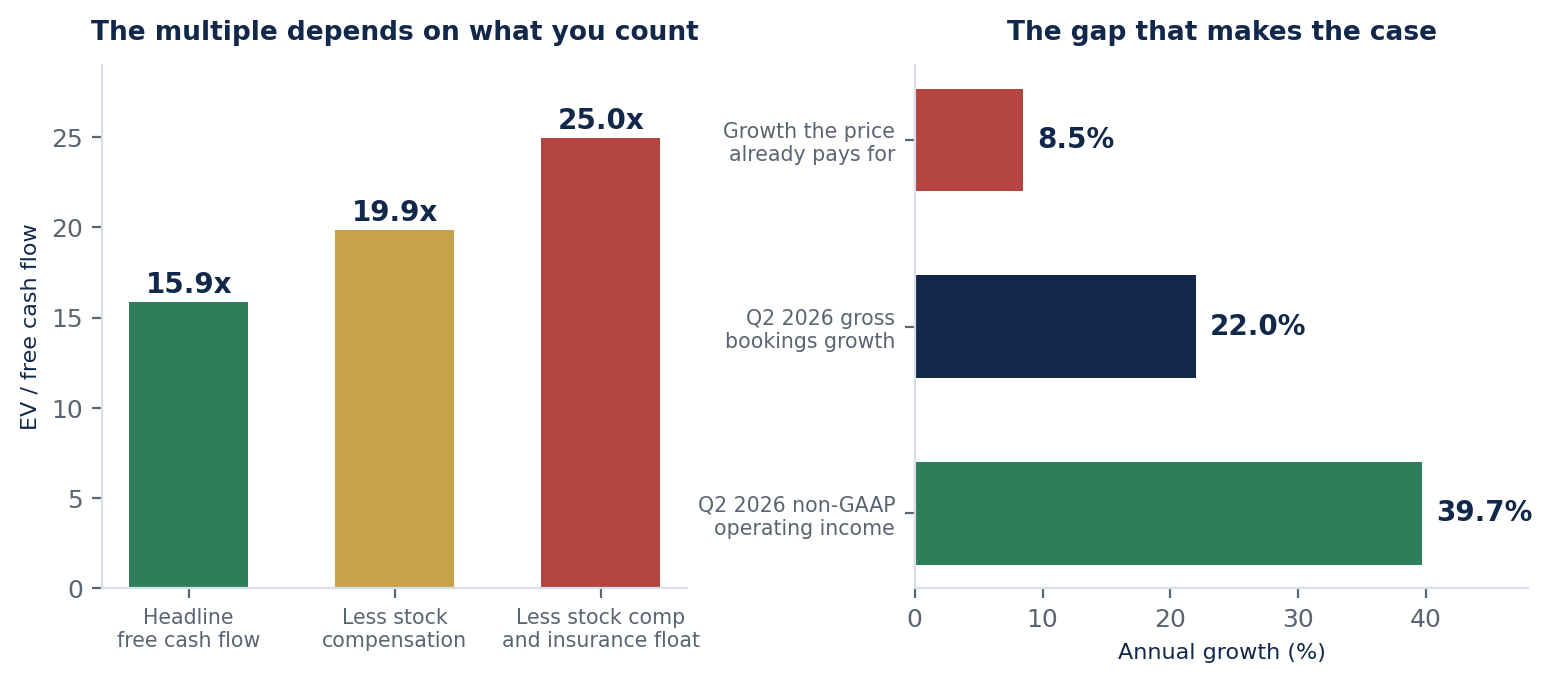
The gap between those two facts is the whole opportunity. Rather than assert a fair value, we ran a reverse discounted cash flow to find out what growth the current price already pays for. The answer is 8.5% a year, fading to 3%, on owner earnings. For that to be the right number, margin expansion has to stop almost immediately and autonomous vehicles have to disintermediate Uber inside the forecast window.
We are not asking you to believe anything heroic. The base case assumes free cash flow grows 13% next year and decays to 3% over a decade. That is well below what the company is doing now, and it still produces $91.
What we are not going to do is pretend the bears have nothing. They have one very good exhibit, and we give it its own section rather than burying it.
| Market cap (diluted) | $154B | Enterprise value | $161B |
| Net debt | $7.3B | From ATH close | -25% |
| Q2'26 gross bookings | $58.0B (+22% cc) | Q2'26 revenue | $14.2B (+12%) |
| Non-GAAP operating income | $2.14B (+40%) | Non-GAAP EPS | $0.81 (+35%) |
| Trailing free cash flow | $10.2B | EV / free cash flow | 15.9× |
| EV / FCF, adjusted | 25.0× | P/E (fwd run-rate) | 24.2× |
| Growth implied by price | 8.5% | Take rate | 24.5% |
The quarter, and why the stock fell on good numbers
Uber reported the June quarter on August 5, 2026. The stock fell about 5% on the print. Understanding why requires separating three numbers that moved in three different directions.
Gross bookings, the volume measure, accelerated. They reached $58.0B, up 24% as reported and 22% in constant currency, on 3,867 million trips, up 18%. Monthly active platform consumers reached 208 million, up 16%.
Revenue, the accounting measure, decelerated sharply. It grew only 12% to $14.2B. Uber attributes 8 percentage points of the shortfall to business model changes, meaning a shift in how certain markets are recognized rather than a change in economics. Consensus wanted $14.27B. This is the miss that moved the stock.
Profit, the measure that matters, compounded. Non-GAAP operating income grew 40% to $2.14B, reaching 3.7% of gross bookings against 3.3% a year ago. Free cash flow was $2.79B.
| Metric | Q2 2025 | Q2 2026 | Change |
|---|---|---|---|
| Gross bookings | $46.8B | $58.0B | +24% |
| Revenue | $12.7B | $14.2B | +12% |
| Trips | 3,268M | 3,867M | +18% |
| Monthly consumers | 180M | 208M | +16% |
| Non-GAAP operating income | $1.53B | $2.14B | +40% |
| Non-GAAP EPS | $0.60 | $0.81 | +35% |
| Free cash flow | $2.48B | $2.79B | +13% |
The pattern is consistent across the year. Non-GAAP earnings per share ran $0.71 in the December quarter, $0.72 in March, $0.81 in June, and the company guides $0.84 to $0.88 for September. Add those four and you get $3.10 of forward run-rate earnings against a $74.99 share price, or 24.2 times.
What the price already assumes
The bull case for Uber is usually stated as a multiple: the company generated $10.2B of trailing free cash flow against a $154B market capitalization, so the stock trades at roughly 16 times cash flow. We do not think that framing survives contact with the cash flow statement.
Two adjustments are mandatory. First, stock-based compensation ran $1,023M in the first half. It is a real cost to existing owners and it is absent from free cash flow by construction. Second, Uber's insurance reserves grew $830M in the half. That is genuine cash, but it is float that arrives because the business is growing and it will not keep arriving at the same rate forever.
| Free cash flow basis | Amount | EV / FCF |
|---|---|---|
| Headline, trailing twelve months | $10.15B | 15.9× |
| Less stock compensation | $8.11B | 19.9× |
| Less stock compensation and float | $6.45B | 25.0× |
A note on method. Trailing twelve-month free cash flow computed as fiscal 2025 less the first half of 2025 plus the first half of 2026 gives $10,153M. Simply doubling the first half of 2026 gives $10,156M. The two routes differ by $3M, which is why we are comfortable using the annualized figure for the adjustments above.
The reverse discounted cash flow
We discount owner earnings of $8.11B, being free cash flow less stock compensation, over ten years with a linear fade to 3% terminal growth. At a 9.0% discount rate the market is paying for 6.5% growth. At the 9.5% rate we use throughout this report, it is 8.5%. Either figure is far below what the business is currently delivering.
| Year-one FCF growth | Fair value | vs. price |
|---|---|---|
| 8% | $73.45 | -2.1% |
| 10% | $79.97 | +6.6% |
| 13% | $90.70 | +20.9% |
| 15% | $98.52 | +31.4% |
| 18% | $111.36 | +48.5% |
We are not assuming Uber keeps growing at 22%. We are assuming it grows free cash flow at 13% next year and decays steadily from there. The stock clears today's price on any assumption above roughly 9%.
The bear case, and the one exhibit that should worry you
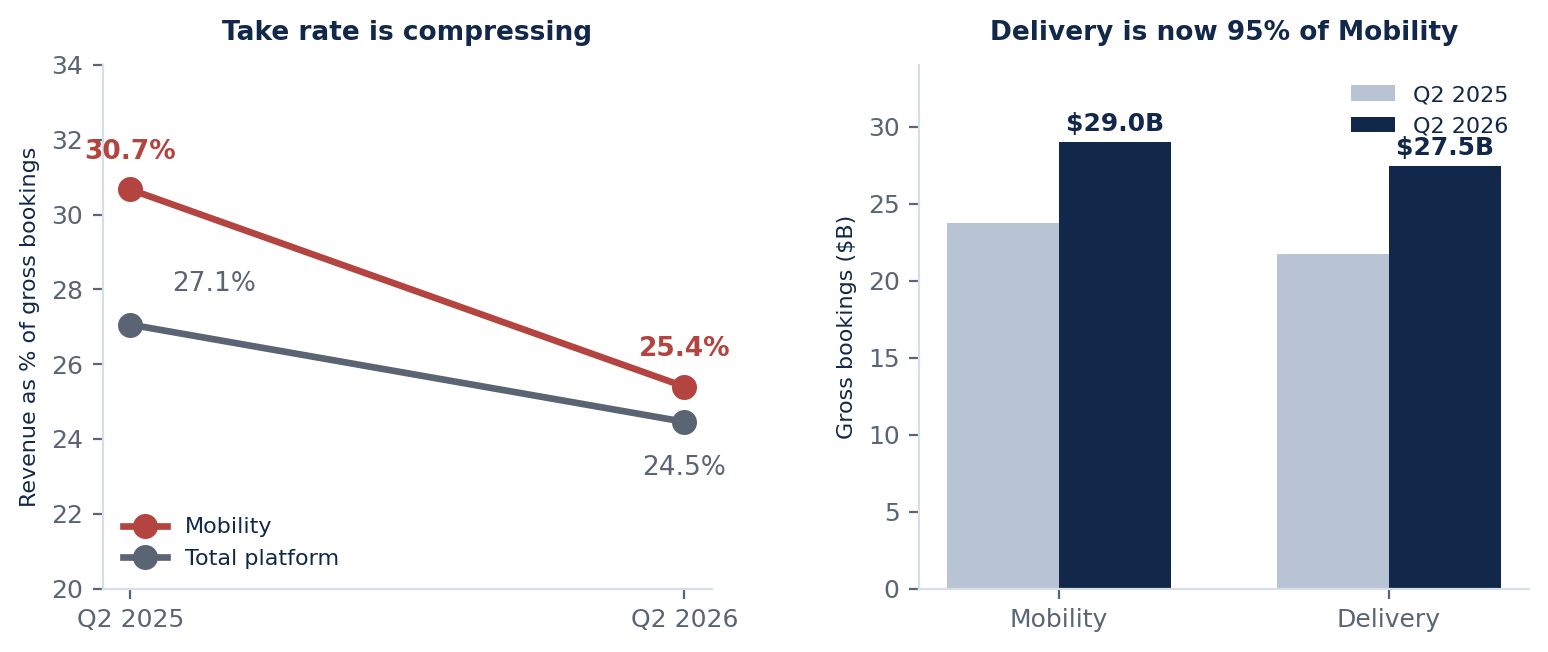
We promised the bears their best evidence, so here it is without softening. Uber's take rate is compressing, and Mobility's is compressing fast.
| Take rate | Q2 2025 | Q2 2026 | Change |
|---|---|---|---|
| Total platform | 27.1% | 24.5% | -2.6 pts |
| Mobility | 30.7% | 25.4% | -5.3 pts |
| Delivery | 18.9% | 19.1% | +0.2 pts |
Mobility revenue grew 1%, from $7,288M to $7,363M, while Mobility gross bookings grew 22%. Management's explanation is accounting: a shift to an agency model in certain markets means Uber books a net commission rather than a gross fare. We have read the disclosure and we find it credible.
But credible is not the same as harmless. If you are valuing Uber on revenue, or on any multiple that runs through revenue, the denominator just changed by five percentage points of Mobility take rate and you will draw the wrong conclusion. It is also fair to note that an accounting explanation for one quarter becomes a trend if it recurs, and we will be watching the September print specifically for whether Mobility revenue reaccelerates.
The second bear argument: autonomy
In July 2026, Uber and Waymo ended their exclusivity arrangement in Atlanta and Austin, and press reports suggested Waymo was weighing an exit from the partnership altogether. This is the real risk, and it is not an accounting artifact.
The bear thesis runs like this. Uber's value is demand aggregation. In a world of autonomous fleets, the fleet owner has the expensive asset, the marginal cost of a ride collapses, and the fleet owner has every incentive to own the customer relationship rather than rent it from Uber. Uber becomes a thinner intermediary earning a smaller cut of a commoditized service. In that world the terminal value in our model is far too generous.
We take this seriously enough that it drives our discount rate. We use 9.5% rather than the 9.0% we would normally apply to a business with these cash flow characteristics, precisely because the terminal question is genuinely open. That single change reduces fair value from $122 at 9.0% and 18% growth to our published $91.
Three more things we are not dismissing
- Second-quarter buybacks fell to $518M from $1,363M a year earlier, a 62% reduction, while $1,640M went into total return swaps. Capital allocation is becoming more complex, not less.
- Uber launched a takeover bid for Delivery Hero in July 2026. A large acquisition would consume the cash that currently supports the buyback.
- A California law change opens the door to driver unionization, a live cost risk to the independent-contractor model. Uber Freight separately disclosed a data security incident in August 2026.
The bull case
Our case does not rest on autonomy being a fiction. It rests on three things the current price does not appear to credit.
One. Delivery has become a second business, and it is not AV-exposed
Delivery gross bookings reached $27.5B in the quarter, or 95% of Mobility, growing 26% against Mobility's 22%. Delivery segment operating income grew 38% to $1,055M.
Delivery earns 3.8% of gross bookings against Mobility's 7.6%, so the mix shift is dilutive to blended margin. That is a real cost. But an autonomous car does not carry a burrito up three flights of stairs, and the market appears to be applying Mobility's terminal risk to the entire enterprise.
Two. Uber responded to the Waymo problem by refusing to have one partner
Since July 2026 Uber has expanded its partnership with Pony.ai to deploy more than 2,000 robotaxis across four European cities plus the Middle East, signed Hinomaru Kotsu to operate an autonomous fleet pilot in Tokyo, and taken an investment in and partnership with Zipline for drone delivery. The strategic posture is deliberate: convert a single-partner dependency into a portfolio in which no supplier has leverage.
Autonomous supply is capital-intensive and rolls out city by city under separate regulatory regimes. Demand aggregation across 70 countries is not easily rebuilt. Uber has 208 million monthly consumers and 50 million Uber One members who account for roughly half of gross bookings. That is the asset the bear case has to destroy, and destroying it takes longer than a twelve-month horizon.
Three. The earnings are higher quality than they look
Two details in the reconciliations deserve credit. Uber's non-GAAP operating income of $2,143M does not add back the $550M of stock compensation in the quarter. Most companies presenting a non-GAAP operating figure do add it back. Separately, management stated that adjusted EBITDA, which does exclude stock compensation, is no longer a key measure and is being retired.
We will be even-handed about the other direction. GAAP diluted earnings per share of $1.17 includes a $1,600M pre-tax benefit from revaluing Uber's equity investments. Tax that at the 24% non-GAAP rate and strip it out and clean GAAP earnings per share is $0.57, which is below the $0.81 non-GAAP figure. The difference sits mostly in legal and regulatory reserve changes that management excludes. Investors quoting the GAAP number as evidence of a cheap multiple are quoting a number inflated by a one-time gain.
Scenarios
| Bear | Base | Bull | |
|---|---|---|---|
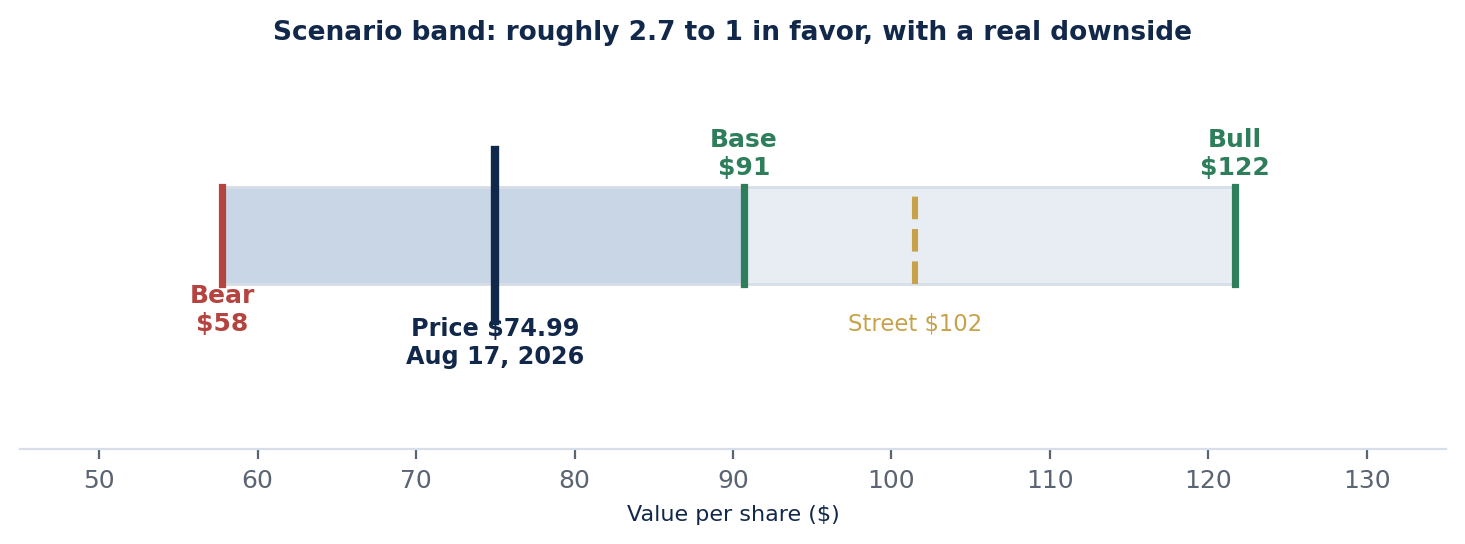
| Year-one FCF growth | 6% | 13% | 18% |
| Discount rate | 10.5% | 9.5% | 9.0% |
| Fair value | $57.77 | $90.70 | $121.68 |
| Return from today | -23.0% | +20.9% | +62.3% |
Bear. Waymo exits the Uber partnership entirely and begins operating consumer-facing demand in major US metros. Mobility take rate keeps compressing beyond the accounting explanation. The Delivery Hero acquisition completes at a full price and the buyback stops. Fair value $58, a 23% loss.
Base. Autonomous rollout continues but slowly and through partners. Mobility revenue reaccelerates once the model change laps. Delivery keeps growing in the mid-twenties and its margin keeps expanding. Fair value $91, a 21% gain.
Bull. Uber becomes the default demand layer for third-party autonomous fleets, taking a durable cut without owning the vehicles. Delivery reaches Mobility's margin structure. Fair value $122. We mention this to be complete, not because we are underwriting it.
| 8% growth | 10% growth | 13% growth | 15% growth | 18% growth | |
|---|---|---|---|---|---|
| r = 8.5% | $88 | $96 | $109 | $118 | $134 |
| r = 9.5% | $73 | $80 | $91 | $99 | $111 |
| r = 10.5% | $63 | $68 | $77 | $84 | $95 |
| r = 11.5% | $55 | $60 | $67 | $73 | $82 |
Risks
| Risk | Likelihood | Impact | What we watch |
|---|---|---|---|
| Waymo exits the partnership entirely | Medium | High | Metro-level exclusivity announcements; Waymo consumer app downloads |
| Mobility take rate keeps falling after the model change laps | Medium | High | Q3 2026 Mobility revenue growth versus gross bookings growth |
| Delivery Hero deal completes at a full price | Medium | Medium | Deal terms, financing mix, buyback pace after close |
| Driver reclassification or unionization raises unit costs | Medium | High | California implementation; EU platform work directive |
| Buyback continues to shrink | Medium | Medium | Quarterly repurchase line versus the total return swap line |
| AV partner concentration in Chinese suppliers draws restrictions | Low | Medium | Pony.ai European deployment approvals |
| Insurance reserve development runs against Uber | Low | High | Reserve build versus gross bookings growth |
Where we could be wrong in method, not just in outcome
- We treat the insurance reserve build as a non-recurring benefit and strip it entirely. If the float is genuinely durable while Uber grows, we are understating owner earnings and fair value is higher.
- We use a single discount rate across a business with two very different risk profiles. A sum-of-the-parts treating Delivery separately would likely produce a higher number.
- Our terminal growth of 3% is a convention, not a forecast. It carries more of the valuation than we would like, which is inherent to discounting a business whose terminal state is contested.
Related research
Reports that make a similar argument about a different business. Every call on this site is dated, public and scored the same way, whether it worked or not.
- Booking Holdings, the same argument about a platform the market is underpricing on growth.
- Palantir, the other growth name, where we reached the opposite conclusion.
- Taiwan Semiconductor, a third BUY where the market is paying for less than the business is delivering.
The full list, with the price each call was made at, is on the scoreboard.
Sources & scoring
All company figures are taken from primary sources: the second quarter 2026 earnings release filed as Exhibit 99.1 to Form 8-K on August 5, 2026, together with its condensed consolidated financial statements; the fourth quarter and full year 2025 release of February 4, 2026; and the first quarter 2026 release of May 6, 2026. Every figure in this report was computed by script from those documents. None was transcribed from a secondary summary.
The reference price of $74.99 is the closing price on August 17, 2026, the last trading day before publication. Consistent with our corrections policy it was verified against multiple independent sources before this report was written: two agreed on $74.99 and a third quoted $75.01, which was rejected as an outlier. The prior session closed at $75.95. The all-time closing high of $100.10 was set on October 6, 2025. Uber has not effected a stock split, so no per-share restatement applies.
This call will be scored on August 18, 2027 against the total return of the S&P 500 over the same period. A BUY is recorded as correct if the excess return of UBER over the benchmark is positive. The rule was fixed before the result is known and will not be revised afterward. See how calls are scored.
The full 8-page research note
Everything above plus the financial summary, the full risk matrix, and methodology.